Moin' moin'!
Today I will talk about the following resources in language courses: listening, speaking, reading and writing. Although language courses are more and more multimodal, this is, they integrate and develop all of those skills "equally", this has not been the whole time this way. New technologies have permitted a new world and setting for language learning, specially for listening and speaking resources.
Here we go!
Listening
Listening activities were daily and very frequent. The first activity was merely listening to the teacher, if he spoke the language beeing learned, of course. Then we did typicall listening activities (content-based) which were part of the textbook exercises, for instance: "listent to the conversation and answer the questions below.". Usually all of the listening exercises were didactic material, therefore sounded raher artificial and not real. I was terrified when I did French listenings, because I knew that in real context, people spoke at least three times faster and used different registers... Lately YouTube has been introduced in every language class (you can even learn a language through YouTube Channels!). I have to say that not many teachers read aloud and sometimes, If they would, specially when working on language through literature, they should read more and then encourage students to read out loud for the rest of the class, I really liked it when my Spanish primary teacher red us stories.
A very common activity in the language learning setting is listening to songs and filling up the gaps in the lyrics with the missing word. This activity is nice the first time, but the second time and the third not that much... It would be more interesting if the students prepare it with songs and words they have learned at home and then show to the rest of the class. Most of the listening activities I have done in class were based on didactic materials rather than authentic materials, which I think is more enjoyable as a language learner. I always listent to authentic material outside the classroom.
Here is the first song I ever did a listening activity on:
The Bangles - Eternal Flame
Speaking
From dialog repetition, communicative activities, theater plays, role playing, games to problem-solving have I improved my oral expression. Because of the nature of speaking, most of the activities required at least one partner, if not a whole group of more than three people. The most frequent activities were dialog repetition with no doubt -easy way of memorizing structures and patterns related to specific purposes... I would love to practise a lot more with theater plays and role playing: when you feel you experience; when you experience, you integrate language. I have learned the languages I know basically by means of speaking (specially conversation). Dialog repetition falls into the pitfalls of short-term memorizing... why don't work on a theater play (which also has the memorizing component) to improve oral skills? When students forget about language as the subject, they start developing good skills: instead of just studying it, they USE it!
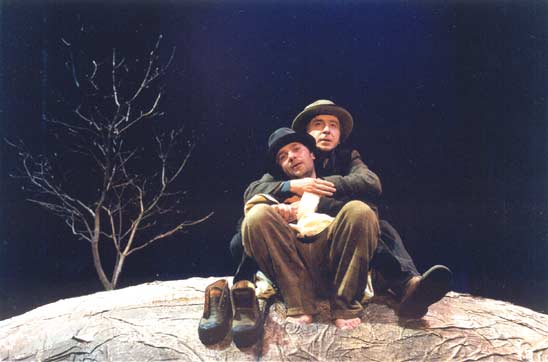
My favourite theater play I did in a foreign language has been En attendant Godot (Samuel Beckett, 1957), from which I represented this extract:
VLADIMIR. - On attend Godot.
ESTRAGON. - C'est vrai. (Un temps.) Alors
comment faire ?
VLADIMIR. - Il n'y a rien à faire.
EsTRAGON. - Mais moi je n'en peux plus.
VLADIMIR. - Veux-tu un radis ?
ESTRAGON. - C'est tout ce qu'il y a?
VLADIMIR. - Il Y a des radis et des navets.
EsTRAGON. - Il n'y a plus de carottes ?
VLADIMIR. - Non. D'ailleurs tu exagères
avec les carottes.
ESTRAGON. - Alors donne-moï un radis. (Vladimir
fouille dans ses poches, ne trouve que des
navets, sort finalement un radis qu'il donne à
Estragon qui l'examine, le renifle.) Il est noir !
VLADIMIR. - C'est un radis.
EsTRAGON. - Je n'aime que les roses, tu le
sais bien !
VLADIMIR. - Alors tu n'en veux pas ?
ESTRAGON. - Je n'aime que les roses !
VLADIMIR. - Alors rends-le-moi.
Estragon le lui rend.
EsTRAGON. - Je vais chercher une carotte.
Il ne bouge pas.
VLADIMIR. - Ceci devient vraiment insignifiant.
EsTRAGON. - Pas encore assez.
VLADIMIR. - Si tu les essayais ?
EsTRAGON. - J'ai tout essayé.
Silence.
VLADIMIR. - Je veux dire, les chaussures.
EsTRAGON. - Tu crois ?
97
VLADIMIR. - Ça fera passer le temps. (Estragon
hésite.) Je t'assure, ce sera une diversion.
EsTRAGON. - Un délassement.
VLADIMIR. Une distraction.
EsTRAGON. -- Un délassement.
VLADIMIR. - Essaie.
ESTRAGON. - Tu m'aideras ?
VLADIMIR. - Bien sûr.
ESTRAGON. - On ne se débrouille pas trop
mal, hein, Didi, tous les deux ensemble ?
VLADIMIR. - Mais oui, mais oui. Allez, on
va essayer la gauche d'abord.
ESTRAGON. - On trouve toujours quelque
chose, hein, Didi, pour nous donner l'impression
d'exister ?
Retrieved from https://monoskop.org/images/f/f5/Beckett_Samuel_En_attendant_Godot_1957.pdf
Reading
We used to work with extracts of texts with both open or closed questions, usually more closed questions than open questions. Close questions focalized on grammar and language structure, and open questions on content and reading comprehension. I also enjoyed the most working with authentic materials, taken from original literature. Cloze tests are a classic for every language learner, focusing mainly on vocabulary or verb conjugation. Reading aloud activities were not so common, which is a pity. Dictation can be much more attractive when students get to read outloud authentic material. Reading Margarite Duras' L'Amant outloud was delightful:
 As reading out loud is not one of the most common activities in language learning, I keep this activity as a habit, to myself.
Comparing texts was a classic activity to understand register across a language. Style as well. Only by comparing different styles and contexts, you fully understand these concepts of register, simplicity and elegance in writing. It is also very interesting to compare different authors across time.
Last but not least, reading books is a necessity, a vital habit. It is a shame that in a language course no books are suggested or read in class, as it is a basic on going tool which does much more than we imagine to improve not only language skills, but a whole understanding of a language's culture and way of thinking. I am currently reading The Bell Jar(Sylvia Plath, 1963).
Remember,
 !
!

Writing
Writing activities have been usually individual but not free compositions. Specially in language learning a topic is always defined in a situational manner: write a letter to a friend about your holidays; write a reciepe; write an essay on bilingualism; write your CV, and so on. Free compositions are not common in language classes because of the need to fullfill language curricula in the stile of "how to do X..." I do not really agree with this. Although you need to learn how to write functional texts, exploring one's creativity should be as well integrated in writing expression tasks and activities. Aditionally, creativity does not just come by free composition: guided or controlled tasks, if good oriented (e.g., a beginning sentence or a picture is given) help to create more original texts without missing the grammar or vocabulary components (we can choose specific guidelines).
Usually a dictionary is used for writing activities but not during classes. It is most used at home, when students prepare their writings alone (or in pairs...). If we can use the dictionary, the teacher would always tell us to bring it to class (as well as a computer).
Final correction are mostly formative and focus on form rather than content. The typical image of a correction is the students paper with a red pen notes aside of the original text. The most common also is to show the students how their writing will be assessed (2 points for content, 2 for language use, 2 for vocabulary and 3,5 for syntax). In my opinion there is a lack of positive feed-back, even when the assessment is formative. It is very important to keep good writing habits in all languages, no matter which level we are at (interlanguage).
I like to write personal diaries about my everyday life, as well as my thoughts and feelings regarding my experiences and try to write in every language I know.
I like to write personal diaries about my everyday life, as well as my thoughts and feelings regarding my experiences and try to write in every language I know.

Cap comentari:
Publica un comentari a l'entrada