divendres, 3 de juny del 2016

7th Post: Resources.

Moin' moin'!

Today I will talk about the following resources in language courses: listening, speaking, reading and writing. Although language courses are more and more multimodal, this is, they integrate and develop all of those skills "equally", this has not been the whole time this way. New technologies have permitted a new world and setting for language learning, specially for listening and speaking resources.

Here we go!


Listening

Listening activities were daily and very frequent. The first activity was merely listening to the teacher, if he spoke the language beeing learned, of course. Then we did typicall listening activities (content-based) which were part of the textbook exercises, for instance: "listent to the conversation and answer the questions below.". Usually all of the listening exercises were didactic material, therefore sounded raher artificial and not real. I was terrified when I did French listenings, because I knew that in real context, people spoke at least three times faster and used different registers... Lately YouTube has been introduced in every language class (you can even learn a language through YouTube Channels!). I have to say that not many teachers read aloud and sometimes, If they would, specially when working on language through literature, they should read more and then encourage students to read out loud for the rest of the class, I really liked it when my Spanish primary teacher red us stories. 


A very common activity in the language learning setting is listening to songs and filling up the gaps in the lyrics with the missing word. This activity is nice the first time, but the second time and the third not that much... It would be more interesting if the students prepare it with songs and words they have learned at home and then show to the rest of the class. Most of the listening activities I have done in class were based on didactic materials rather than authentic materials, which I think is more enjoyable as a language learner. I always listent to authentic material outside the classroom. 

Here is the first song I ever did a listening activity on:

The Bangles - Eternal Flame


Speaking

From dialog repetition, communicative activities, theater plays, role playing, games to problem-solving have I improved my oral expression. Because of the nature of speaking, most of the activities required at least one partner, if not a whole group of more than three people. The most frequent activities were dialog repetition with no doubt -easy way of memorizing structures and patterns related to specific purposes... I would love to practise a lot more with theater plays and role playing: when you feel you experience; when you experience, you integrate language. I have learned the languages I know basically by means of speaking (specially conversation). Dialog repetition falls into the pitfalls of short-term memorizing... why don't work on a theater play (which also has the memorizing component) to improve oral skills? When students forget about language as the subject, they start developing good skills: instead of just studying it, they USE it!
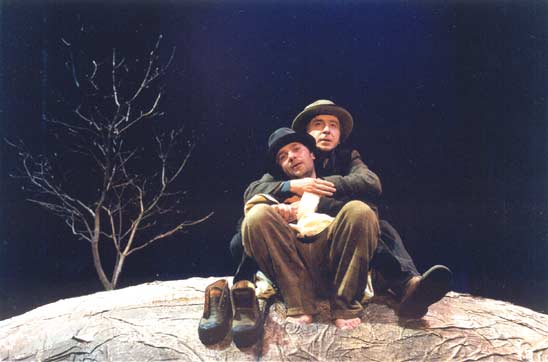

My favourite theater play I did in a foreign language has been En attendant Godot (Samuel Beckett, 1957), from which I represented this extract:

VLADIMIR. - On attend Godot. 
ESTRAGON. - C'est vrai. (Un temps.) Alors comment faire ? 
VLADIMIR. - Il n'y a rien à faire. 
EsTRAGON. - Mais moi je n'en peux plus. 
VLADIMIR. - Veux-tu un radis ? 
ESTRAGON. - C'est tout ce qu'il y a? 
VLADIMIR. - Il Y a des radis et des navets. 
EsTRAGON. - Il n'y a plus de carottes ?
VLADIMIR. - Non. D'ailleurs tu exagères avec les carottes. 
ESTRAGON. - Alors donne-moï un radis. (Vladimir fouille dans ses poches, ne trouve que des navets, sort finalement un radis qu'il donne à Estragon qui l'examine, le renifle.) Il est noir ! 
VLADIMIR. - C'est un radis. 
EsTRAGON. - Je n'aime que les roses, tu le sais bien !
 VLADIMIR. - Alors tu n'en veux pas ? 
ESTRAGON. - Je n'aime que les roses ! 
VLADIMIR. - Alors rends-le-moi. Estragon le lui rend. 
EsTRAGON. - Je vais chercher une carotte. Il ne bouge pas. 
VLADIMIR. - Ceci devient vraiment insignifiant.
EsTRAGON. - Pas encore assez. 
VLADIMIR. - Si tu les essayais ? 
EsTRAGON. - J'ai tout essayé. Silence. 
VLADIMIR. - Je veux dire, les chaussures. 
EsTRAGON. - Tu crois ? 97 
VLADIMIR. - Ça fera passer le temps. (Estragon hésite.) Je t'assure, ce sera une diversion. EsTRAGON. - Un délassement. 
VLADIMIR. Une distraction. 
EsTRAGON. -- Un délassement. 
VLADIMIR. - Essaie. 
ESTRAGON. - Tu m'aideras ? 
VLADIMIR. - Bien sûr. 
ESTRAGON. - On ne se débrouille pas trop mal, hein, Didi, tous les deux ensemble ?
 VLADIMIR. - Mais oui, mais oui. Allez, on va essayer la gauche d'abord. 
ESTRAGON. - On trouve toujours quelque chose, hein, Didi, pour nous donner l'impression d'exister ? 

Retrieved from https://monoskop.org/images/f/f5/Beckett_Samuel_En_attendant_Godot_1957.pdf


Reading

We used to work with extracts of texts with both open or closed questions, usually more closed questions than open questions. Close questions focalized on grammar and language structure, and open questions on content and reading comprehension. I also enjoyed the most working with authentic materials, taken from original literature. Cloze tests are a classic for every language learner, focusing mainly on vocabulary or verb conjugation. Reading aloud activities were not so common, which is a pity. Dictation can be much more attractive when students get to read outloud authentic material. Reading Margarite Duras' L'Amant outloud was delightful:

http://art-psy.com/PDF/Duras.pdf


As reading out loud is not one of the most common activities in language learning, I keep this activity as a habit, to myself. 

Comparing texts was a classic activity to understand register across a language. Style as well. Only by comparing different styles and contexts, you fully understand these concepts of register, simplicity and elegance in writing. It is also very interesting to compare different authors across time. 

Last but not least, reading books is a necessity, a vital habit. It is a shame that in a language course no books are suggested or read in class, as it is a basic on going tool which does much more than we imagine to improve not only language skills, but a whole understanding of a language's culture and way of thinking. I am currently reading The Bell Jar(Sylvia Plath, 1963). 

Remember,

 !


Writing

Writing activities have been usually individual but not free compositions. Specially in language learning a topic is always defined in a situational manner: write a letter to a friend about your holidays; write a reciepe; write an essay on bilingualism; write your CV, and so on. Free compositions are not common in language classes because of the need to fullfill language curricula in the stile of "how to do X..." I do not really agree with this. Although you need to learn how to write functional texts, exploring one's creativity should be as well integrated in writing expression tasks and activities. Aditionally, creativity does not just come by free composition: guided or controlled tasks, if good oriented (e.g., a beginning sentence  or a picture is given) help to create more original texts without missing the grammar or vocabulary components (we can choose specific guidelines). 

Usually a dictionary is used for writing activities but not during classes. It is most used at home, when students prepare their writings alone (or in pairs...). If we can use the dictionary, the teacher would always tell us to bring it to class (as well as a computer). 

Final correction are mostly formative and focus on form rather than content. The typical image of a correction is the students paper with a red pen notes aside of the original text. The most common also is to show the students how their writing will be assessed (2 points for content, 2 for language use, 2 for vocabulary and 3,5 for syntax). In my opinion there is a lack of positive feed-back, even when the assessment is formative. It is very important to keep good writing habits in all languages, no matter which level we are at (interlanguage). 

I like to write personal diaries about my everyday life, as well as my thoughts and feelings regarding my experiences and try to write in every language I know. 


6th Post: Questions about the organization of my classes


Typical deductive method textbook
I have been a victim of strict learning standards objective-based language learning courses (what is this sentence?!). Formal education is strictly related to learning standards, goals to achieve by every student, almost to the same extent (we are all different! how come can this be demanded?). Objectives are needed and somehow, standards as well, but they have to be flexible and, needless to say, they are not. I had not heard of Bloom's taxonomy before, but now I know that I have been taught most of all subjects in my life according to this taxonomy. I do believe there is a certain need to integrate basic content to understand further notions and structures, but not all content requires following a specific progressive order (I made the same point in the last post).

In my native language classes a deductive method was preferred and used. The inductive was used too, but as an alternative, when some concepts were not clear, or needed another point of view to be understood. I agree with my colleagues that both methods are useful and need to be integrated in the curricula and the method or theories been used in class. They somehow complement each other and give different points of view of the same topic. If research usually tries to cover both of those methodologies, why shouldn't language teaching do not so?

Warm-up activities were and still are daily occurrences, although they are sometimes just used in the beginning of the courses, not as a daily routine... Most of the textbooks and activities were mechanical (never ending workbook grammar exercises...) and controlled exercises, which I have found to stroke creativity most of the times, as well as blocking autonomous learning. I remember a really good English language seminar at Pompeu Fabra, in which communicative tasks were encouraging and helped me to integrate and broaden my English interlanguage.


I remember having started to work through project-based learning tasks (case studies, Problem-Based Learning) at university, but not really focused on language learning. These tasks were mostly designed to do in groups of three or four people and the more we have worked in groups, the more we feel like the pictures above every time a teacher asks us to do so...  


progressive enragement on "working in groups"

It is not that we are against cooperative working, but the types of tasks we have to do as a team. Mostly we do not choose if we wish to do so or not; not even in university... If we could choose a group from the beginning instead of changing groups every second, we would probably learn much more than now. We do not even get used to our colleagues and their working PLE. A good team work is a balanced combination of information based on one's PLE and shared with the rest of the group. However, no such thing really happens (not in the classroom at least...). There are groups, but we all work individually and paste all the parts together... I do not think we can call this team work...This is at its worse when we have to translate text in groups, for example.  

5th Post: My Syllabus


Hello again! I hope you are doing well! Today's post will focus on the syllabus of language courses.

When I think of all syllabuses I have followed learning languages, the general pattern I observe consists of levels and progressive contents: from the basics (easy) to the complex (difficult). At first sight, it seems a very logical way of proceeding, but a flaw of it is that, usually, the difficult or more complex parts are hidden to the learner as if, as student, one is not capable to cope with more advanced aspects of language. Here I do not mean that I wished to learn more difficult things sooner, but that this content could be available if it was useful in order to understand basic stages. I would say the same happened to me in maths classroom, for example. If complicated aspects arose, they were sort of considered as the "dark side". In this way, it is not that progressive syllabus is bad, but not everything is progressive in itself, and usually it is necessary to jump steps forwards or steps backwards to understand languages as a whole.

Spanish textbook syllabus
I would divide the courses I followed into two groups, the first one consisting of Catalan, Spanish and English and the other one, of French and German (which I actually never studied formally...). This distinction I make exclusively for this post, since I have had different syllabuses for those languages in formal education environments.


Spanish textbook syllabus
The former group was very much characterized by the point I was trying to make on progressiveness. I studied all of them in according to traditional grammar, since the classes where planned following basically the textbooks used. How were the textbooks organized? In units, from the easiest topic to the most complex. It was the same structure all over again: from names, modifiers, adjectives, verb, subordinate.... to syntactical structures: simple sentences with the ver to be, full simple sentences, subordinate clauses... And all these contents where ridiculously camouflaged with different topics of interest from the immediate environment (food, transportation, school, sports, etc.) and communicative functions. Sadly, the major focus was on grammar (syntax and PoS) and few time was left to debate on different topics of interest -here the notion of interest is somehow ironic... how can, for instance, sports (the same vocabulary and texts on sports) be of interest?, and to practice communicative functions


4th Post: Methods experienced as a language learner

Hello again! Today's post is about teaching methods experienced as a language learner. I will make a general overview of all methods existing and how those were related to my language courses. I have not experienced just one of them or very specific tasks on one method; rather a fusion of methods within methods, which I think is very good (if you know how to combine them...). Again, as I said in one of my first posts for psychological theories, methods are not diametrical. 


A corrected translation I did back in "batxillerat"
Grammar-translation was not bad for learning Latin, but far too traditional seen under a general language teaching scope. In high-school I had a good teacher, but he stood quite a lot on translating and memorizing concepts. The one who knew the most was (is) the best. Finito. This latin teacher (known as latin lover) in Súnion, who taught us memorization techniques and played games with us in class, to make the “memorization” process much easier and delightful. If not, I would have hated Latin. Translating Latin texts is fine according to this method; honestly it is hard for me to think of other ways it could be taught. However, if you chose the right tasks to introduce the texts (literature and cultural aspects of ancient Rome), it is better for students. He didn’t only evaluate our translation-grammar skills, but our interest in Latin culture (watching series such as I, Claudius) and designed a roman “identity” card for which we had extra points if we brought to class, and showed that we became proper roman citizens all along the course. In the end Latin is already a dead language, and I honestly can’t figure out of a better method. Nevertheless, if role plays are introduced (let’s pretend we are romans) changes the environment. Although we cannot hear the language or talk fluently Latin with each other, we get to practise some phrases and structures, which remain in my memory without spending four hours in the library learning Latinisms by heart. Sadly, this is hardly avoidable, and happens unfortunately with many language learning stages, especially in high-school (ESO) and “batxillerat”. In this way, living or dead languages do not differ: we still spend much time memorizing concepts, instead of integrating them by means of examples and practice, not just by a dictionary definition.

Link to my Latin teacher’s blog: http://rboixader.blogspot.com.es/


I encourage you to watch if not all, an extract of the wonderful and magisterial British series, I, Claudius... 


Another way to learn harsh climate vocabulary...
Not being “an easy approach to use in school” (Crystal, 2010) I learned languages according to the direct method basically out of my compulsory school time. The main languages I have learned through this method are, firstly English, and then French. When I say learned, I mean that the method helped me integrating the language successfully. To me it is one of the most interesting and complete methods -as well as the one in which other methods can be combined more easily. It is a shame that it is less used in schools (classrooms) for it is difficult to put in practice with groups composed by more than 8-10 people (which can also be too much).
Although I had an excellent English teacher in primary school, I used to reinforce it with a native American teacher who came home and talked to me and my friend, in order to practise oral fluency in English. She basically used this method as if we were in a natural conversation (we never spoke Catalan or Spanish). However, the real approach I put in practise when I "lived" in Paris (two consecutive summers), and in the "Bretagne". This method has much to do with language acquisition, and as my colleague Corin suggests, methodologies do not guarantee successful language learning. I do believe, as well as many classmates do in their blogs, that methods per se are not the key to proficiency levels in any language. We need to make balanced choices on each method to design integrated ways of learning: all depends on the purpose we want to achieve. 


As there is no magic method for losing weight or quitting smoking, there is not one method for language learning. Teachers must guide students to find their own "method" (PLE), whether in class or out of class. 


3rd Post: Psychological theories experienced as a language learner


It is hard to get through if, in the end of the road, what counts are your certificates, there is still a hard behaviourist component underling the rest of psychological theories. you get a 9? Good, you get the best choices. Maybe I have always had a 9. No improvement, no reflection. No thinking. No critical thinking and positive feedback. Stuck. Non-dynamic. Kaput. this is very detrimental, since education is still subordinated (it has to, in some way), to economic needs and employment, focused on the “result” rather than “the process”, the changes from one stage to another (evolution). Although meaningful learning and rot learning are not diametrical (Ausbel, 1968), most of my compulsory education language classes (not to mention other compulsory curricula) focused on rot learning failing to successfully combining both learning approaches ignoring reconstruction of knowledge, which stores knew knowledge in the short term memory, cancelling the proper integration of new ideas, thoughts, etc. This is to me the major flaw across the theories underling compulsory education (from primary school to, and especially, high-school). Still there is a great focus on behaviourism (evaluation focuses on results, not processes) and conductivism. I probably overgeneralized here and didn't really focus on the language learning curriculum, but to me this pattern is still the same in the language learning courses. 


Graphic description of that "bulimic" studying pattern


I have found other psychological theories being more central in non-compulsory education, which doesn’t need to focus on final results, as much as the other theories. Besides, I have encountered people (teachers, educators), rather than schools or institutions, which are truly designing and teaching languages according to Humanistic and Constructivist approaches. This I have experienced in small language academies (French academies) and language tutors (preferably native speakers of the language being tutored). 

The image with the dog is a silly paralellism with how I have been studying many languages across my compulsory education years: if you match PISA requirements in the end, you are supposed to be a good learner... Nevertheless, I have managed to sort out my psychologial modus to get to languages in a more Humanistic way: based on discussion with other classmates, which lead to information exchange and so, to deep learning. Luckily, cognitivist and humanist theories are more present today (little by little) and in higher levels of education. I would say I now enjoy language lessons: I am starting to really understand langugages as a whole, how they work, and how to keep on track with the details and differences that make every language unique. 

This video is encouraging and shows how learning should be, specifically language learning from the day you discover a new language to the day where you can say you master it (no matter what level of interlanguage you are at):


The textbooks I used in school include a little of all psychological theories, from behaviourism to constructivism, and present all kinds of activities. However, they are form and content based, with less emphasis on active learning or cooperative learning.

During primary school we didn't really use textbooks, we used to read a lot of books at the school library and materials where taken from several text books or designed by the teacher. 5th and 6th grade were hard years because the teacher was very demanding, but at the same time, we constructed a strong base in grammar and reading comprehension working with books such as The Little Prince (Antoine de Saint Éxupery, 1943) and El Hombre que plantaba árboles (Jean Giono, 1953). 
Here is a list of the books I used during my highschool years, a Joan Pelegrí:

For Catalan and Spanish we used the complet series of Cruïlla projecte 3.16: http://www.cruilla.cat/cataleg/text


For English (during primary) we used all of the BugsWorld textbooks:


The songs and the stories in the books were absolutely great. We prepared the songs and sung them all together, as well as the stories, which we represented, as a theater show for the rest of the class. 

The materials I used in "batxillerat" where prepared by the language teachers in a dossier way. It is one of the best materials I have ever used for language learning and I still keep them at home as a reference. 


2nd Post: Linguistic theories experienced as a language learner


Hello again! Today's post discusses linguistic theories!This time I have done shorter... (ah, writting about oneself's life is always extremely exciting...). 

When I think of linguistic theories regarding my compulsory schooling years, I cannot help to sum it up in this sentence by Lec: ““Ich hätte viele Dinge begriffen, hätte man sie mir nicht erklärt” (‘I would have understood a lot of things if they wouldn’t have been explained to me’). Why? I feel I have spent far too much time learning languages in a traditional-grammar way, mixed with some generativism and structuralism (parsing activities, some morphology exercises…) and then, later on, in a pragmatic way. Primary school was still all right: we learned to read (it is hard for me to think of another way of learning to read other than reading…), to write and to say something else than: “tinc gana, tinc set, vull anar a casa; la mama, el papa; sí, no.” However, at some point, something happened: we sat just in front of our tiny books which should be helping us, and in this order, to learn about the linguistic unit, the word (names, types of names), the sentence, the paragraph, the text and finally the communicative situation. The same was for all the language courses I took at compulsory school, from primary to high-school (until 4t d’ESO). One year after another: “el nom, l’adjectiu, el verb”…bla, bla, bla… B-O-R-I-N-G!


How are we supposed to learn a language if we basically focus on sentence structure and morphology, out of a real text? I only remember having a special hour for reading (this was, all the class going to the school library) during primary school. After that, excursions to “the temple” were something one didn’t even think about, unless there was a habit at home, with parents or someone at home who encouraged us to go to the library and read, and read, and read again to experience what a name looks like in a real sentence. And then, you are supposed to write a coherent text, with lots and lots of nice new words. How?


In addition, I think that classroom architecture is quite traditional. Few times was there a reorganization of the furniture disposition, in order to bring it all to a more “dialectic” space. Yet, and again I have to reward my primary school, this happened Fridays, when we had the famous “tutories”. All of us sat in front of each other and everybody had to discuss about what happened at school during the week. Still, this was the only hour we got to create a proper oral expression activity.


As far as I have read, my classmates also have been condemning the fact that language teaching (especially in compulsory years) still focuses too much on traditional grammar and structuralism. Actually, pragmatics has been introduced lately, at university (although not really…) and in foreign language courses offered in language academies or at least, this is where I have had the “best” cocktail of linguistic theories. My French and Italian text books include lots of pragmatics (for instance, they focused on how to book a room? How to write an email? and so on), but also grammar, vocabulary, and interesting activities, both for oral and written expression.


The correction of all these activities was in most cases grammatical rather than communicative, and sometimes presentation was quite important (it has to, in some way, but crossing off happens…). The best correction I have ever experienced, and the only one I still keep doing on my own, was during high-school (batxillerat). We wrote a text, once a week, and then the teacher just circled out the mistakes (using a pencil, not a red pen!) so that we had to correct them on our own. Each one of us had their own notebook of “errors i horrors” (‘errors and horrors’).


In the end, to construct a complete overview of the language being learned (and language itself) you need to merge all of the theories mentioned, but I find it quite difficult to merge then in the appropriate way.